
The AI Accountability Shift
Governance Must Move from Managing Tasks to Managing Outcomes

There is a major shift happening in how enterprises must be governed as AI moves from supporting work to directly producing it. As AI agents move from tools that support value delivery to systems that constitute value delivery, the locus of human accountability must shift accordingly—from supervising individual activities to governing high-level outcomes, strategic intent, and ethical constraints. Governance, data architecture, platforms, talent, and operating models all need to be redesigned around this shift.
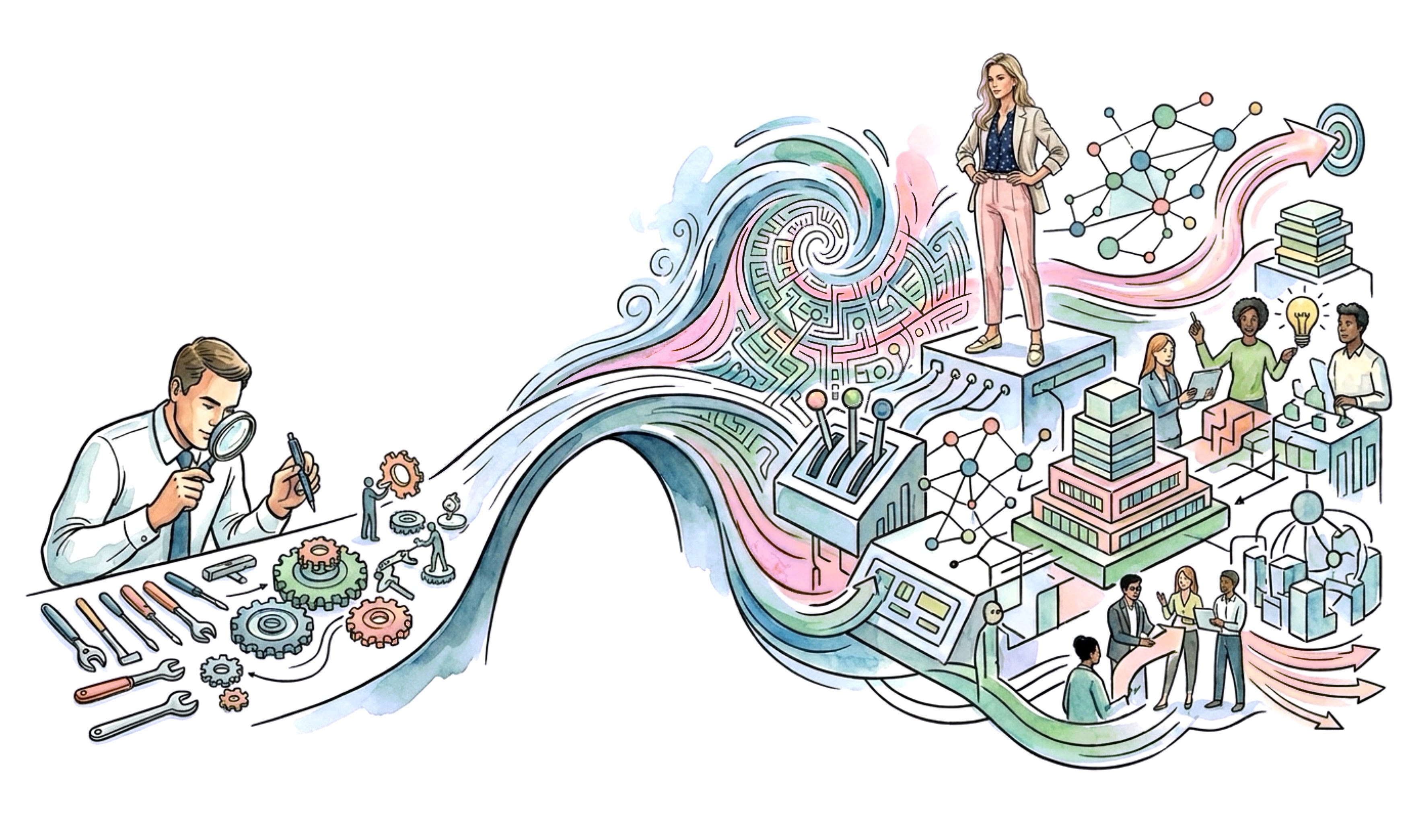
Consider a moment most leaders have lived: every one of us has attended a meeting and walked out with less clarity than when we walked in. A meeting you attend with expectations of being able to answer, “are we on track?” and the answer is a process update rather than a confidence signal.
Someone runs through decisions and deliverables, the actions in progress, the next steps remaining. The system is working, teams are busy, process is being followed, timeline is holding, dashboards are green, output is flowing.
And yet the question that actually matters — are we going to get the outcome we need? — is never quite answered. Leaders leave the meeting with no clear sense of whether any of the workstreams are moving toward what actually matters.
This gap between activity and impact has always existed. Most leaders have felt the discomfort. AI-powered organizations, if nothing changes, are about to feel this at scale.
What Just Changed—and Why it Matters Now
What just changed — and why it matters now AI agents don’t follow your process, they construct it in real time. That’s not a technology update — it’s a governance problem. The “did we follow the right steps?” question no longer has a meaningful answer.
For decades, organizations governed work by defining and supervising processes. Designers created the process, employees executed the process, and leaders supervised the process. Accountability was anchored in activity. The right person, following the right steps, at the right time. It was a model built for predictable, stable, human-authored work — and within those conditions, it functioned well.
AI agents operate on entirely different logic. They do not just follow pre-defined workflows. They can construct them — in real time, adapting to changing conditions, operating at a speed and scale no human team can match. When the process is written and rewritten dynamically by the system executing it, auditing the steps is no longer meaningful. When agentic systems can adapt in real time and execute at scale, step-by-step process supervision becomes incredibly inefficient.
The governing question changes:
From: “Was there a process? Was it followed?”
To: “Did we achieve the right outcome, within defined boundaries?”
The question that replaces it is both simpler and more demanding. This shift from activity governance to outcome governance is the central leadership challenge of the AI era. Not because the technology changed. Because the thing humans are accountable for has changed.
Most organizations have not yet registered this evolution from structured, standardized execution to adaptive execution. They are layering AI onto existing governance structures designed for a different set of assumptions — where humans pre-design and manage every activity.
When organizations ask, "Do we have a process for that? Was it followed?" they are governing the wrong thing entirely.
When Activity-Based Governance Still Makes Sense
The problem isn’t that it is wrong; it’s that the conditions it was built for may soon no longer exist.
The process-first approach was a rational response to the conditions organizations operated in — stable workflows, predictable outputs, human-executed steps where sequence and compliance directly determined quality.
In many contexts, that logic still holds. Surgical procedures. Regulatory filings. Safety protocols. Financial controls. These are domains where the step is the outcome — where deviation from defined process is not inefficiency, it is risk. No governance model, however sophisticated, replaces the discipline of a well-designed checklist in a high-stakes, low-tolerance environment.
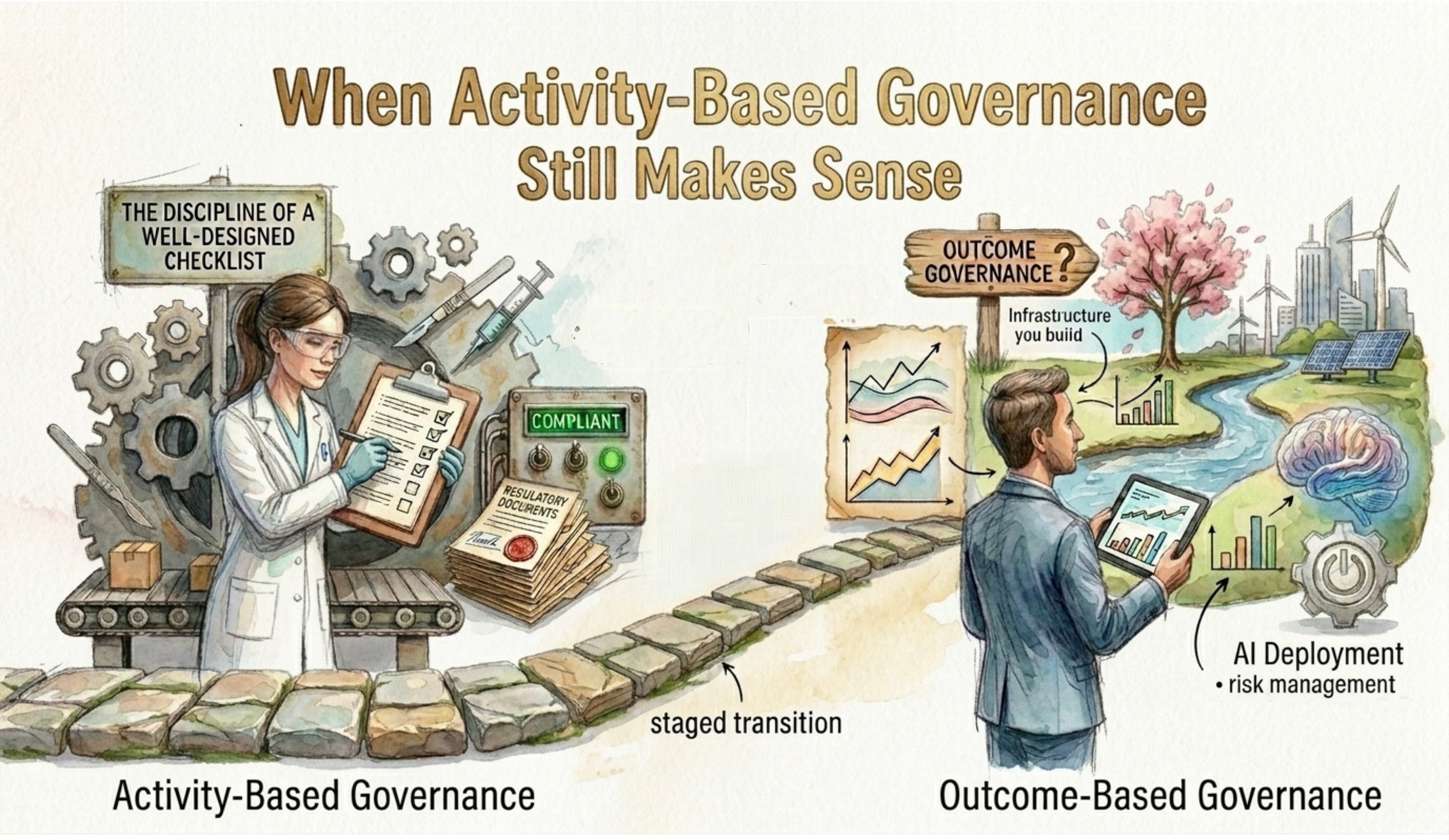
And let’s be honest: AI itself is not yet ready to be governed by outcomes alone. Outcome governance presupposes a baseline of AI reliability — you cannot govern outcomes you cannot yet predict. In organizations where AI capability is nascent, where models are unproven, or where the feedback loops required to detect drift don’t yet exist, activity-level supervision remains the more prudent posture. Trusting the process is not regression; in early-stage AI deployment, it is risk management.
There is a third condition that warrants patience: organizational readiness. Outcome governance is not just a philosophy to adopt — it is infrastructure you build. It requires clear strategic intent, defined guardrails, monitoring systems, and leadership fluency in reading outcomes rather than auditing activities. Where that foundation doesn’t yet exist, the transition will take time.
If your current processes are reliably producing the outcomes you need and you can validate that without excessive overhead, the urgency for disruption has no immediate business case. But standing still has a shelf life. Leadership judgment lives in knowing when that expiration date is approaching — and in not mistaking readiness-building for permission to wait indefinitely.
The competitive landscape doesn't pause for organizational comfort. It is a staged transition — one that requires knowing which parts of your organization have leaders ready to leap ahead and which areas still depend on the discipline of defined process.
Core Human Accountabilities: Three Things That Now Belong to You
As AI absorbs more and more execution, something clarifying happens. The accountabilities that were always most consequential, but were frequently crowded out by operational noise, move to the center. They don’t just remain. When execution pace accelerates and scales, they expand in weight and visibility.
Three accountabilities now define the human role in an AI-powered enterprise. They are not new responsibilities so much as elevated ones — finally freed from the overhead of managing every step.

1. Defining strategic intent
Setting Strategic Goals with Executable Precision
AI executes adaptively. It does not interpret aspiration well — it operationalizes instruction. Which means the quality of what AI delivers is directly determined by the quality of what humans define at the top. Vague intent produces drift at the execution layer. Always has. AI simply makes the consequences arrive faster and at greater scale.
This requires a level of strategic precision most organizations have not previously demanded of themselves.
“Grow market share” is not a goal an AI system can responsibly advance.
“Increase retention among enterprise accounts by 15% within two quarters, without reducing margin” is.
The leadership task is translation: from organizational ambition to concrete, unambiguous design criteria that function as operating instructions.
Leadership shifts from providing answers to defining:
goals
priorities
trade-offs
success criteria
Vague intent at the top produces drift at the execution layer. That translation has always been the hardest part of strategy. And now when it does and doesn’t occur will be even more consequential.
MIT Sloan’s research on AI leadership captures this well: “Leaders are no longer the sole source of answers; they are responsible for framing the right questions, setting guardrails, and contextualizing AI-driven insights within human values and organizational purpose.”
The quality of the strategic framing provided by humans directly determines the quality of outcomes the AI can deliver.
2. Setting guardrails and constraints
Defining the Boundaries Within Which AI Must Operate
In a process-governed organization, humans embedded values and risk tolerance into procedural steps. In an outcome-governed organization, values and risks must be made explicit as constraints — the boundaries within which AI is authorized to act.
Rather than designing workflows step-by-step, the critically human capabilities will be to define boundaries:
ethical parameters (standards, accountability, escalation paths)
legal requirements
risk tolerances
non-negotiable principles (values)
technical guardrails (confidence thresholds, boundary parameters, automated enforcement)
These guardrails are not bureaucratic additions. They are the constitutional layer of AI-mediated work. Where they are well-designed, AI operates with maximum adaptive latitude and delivers maximum value. Where they are vague or absent, AI fills the gap — not with malice, but with indifference to the things that weren’t specified.
Without explicit guardrails, AI systems optimize in ways that may be efficient but misaligned. This is the primary design task since these function as operating rules for autonomous systems.
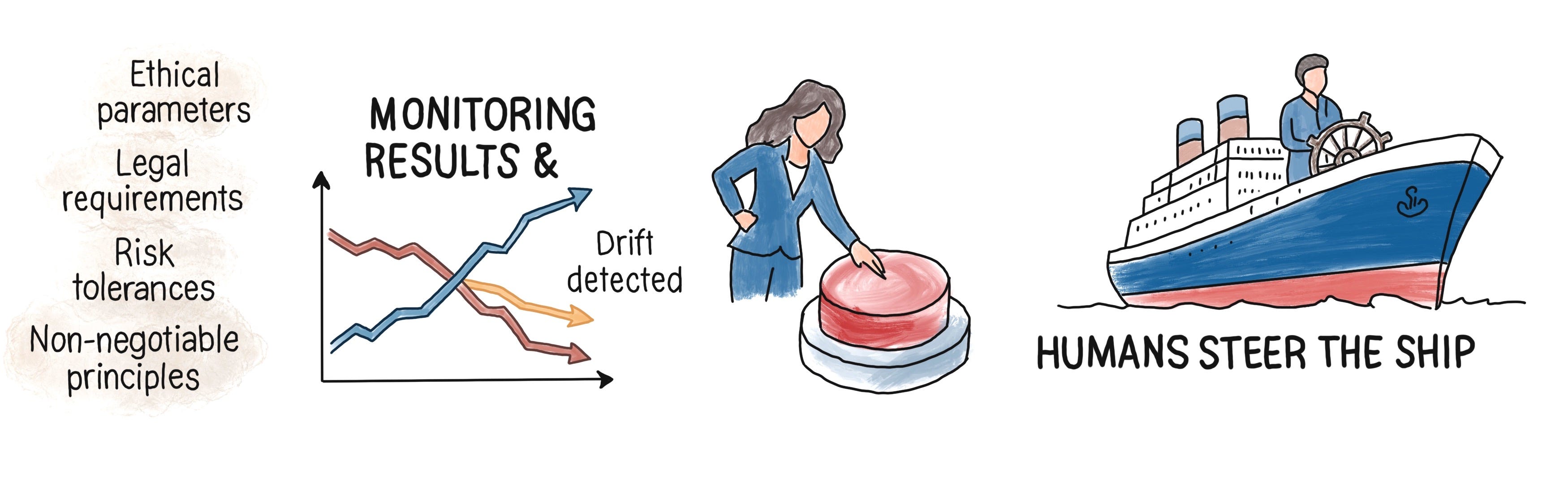
Salesforce has articulated this principle clearly in their own governance philosophy: “Instead of asking humans to intervene in every individual AI interaction, we’re designing more powerful, system-wide controls that put humans at the helm of AI outcomes and enable them to focus on the high-judgment items that most need their attention. Humans aren’t always rowing the boat—but we’re very much steering the ship.”
3. Monitoring results and intervening when needed
Monitoring Outcomes and Intervening with Judgment
Human oversight in an AI-powered enterprise is not passive surveillance. It is active stewardship. It is ongoing responsibility to detect when outcomes are diverging from intent, and to intervene with the kind of contextual judgment no system can replicate.
It requires watching the right signals, understanding what drift looks like before it becomes a crisis, and knowing when to override. The distinction matters: oversight designed around volume (i.e., reviewing everything) collapses under the scale AI operates at. Oversight designed around judgment (i.e., knowing what warrants human attention) scales with it. These ways of working require continuous monitoring of AI performance, auditability of AI-mediated decisions, and clear escalation paths for when systems operate outside acceptable parameters.
McKinsey’s human-centered agentic AI framework reinforces the necessity of intentional design here: “Even sophisticated agentic programs can fail if human input is bolted on as an afterthought. Organizations need to decide where humans stay ‘in the loop,’ where they move ‘above the loop,’ and how people will experience working with agents day to day.”
The question every organization must answer is not whether humans are present in the process. It is whether the humans present are positioned, equipped, and empowered to intervene when it matters as outcome governance becomes the defining function of human leadership.
Governance Shifts Are Necessary. They Are Not Sufficient.
The three accountabilities above represent a fundamental shift in what hu
man leadership is responsible for in an AI-powered enterprise. But redefining accountability is not the same as building the capacity to execute it.
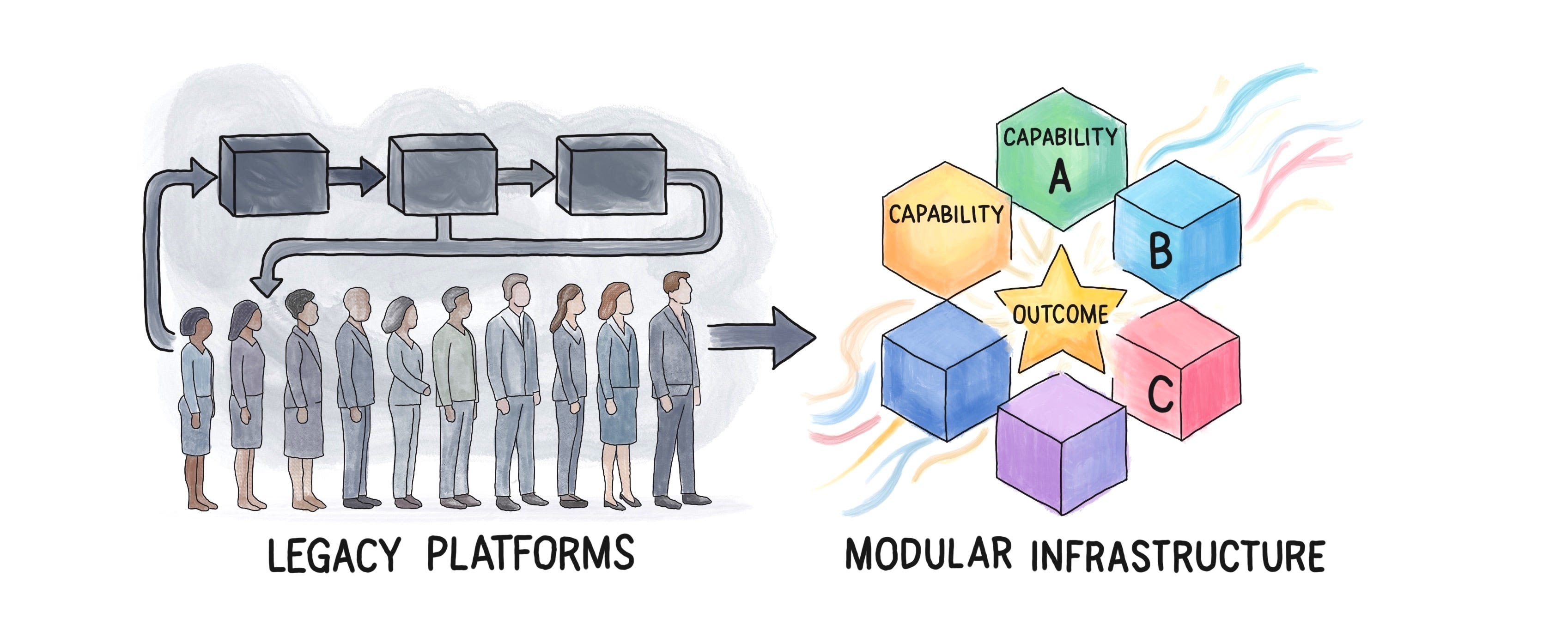
Outcome governance requires three organizational capabilities that most enterprises have not yet developed at the scale this model demands. The first is architectural — legacy, monolithic platforms were designed for sequential, human-executed workflows. Adaptive AI execution requires something fundamentally different: modular, composable infrastructure where capabilities can be dynamically assembled around outcomes rather than locked into fixed processes. The technology must be able to do what the governance model asks of it.
The second is human. Workforce roles, skills, and structures were designed around task execution. An outcome-governed organization requires people who can orchestrate AI systems, manage exceptions that fall outside automated parameters, and exercise the kind of contextual judgment that no system can replicate. That is not a training initiative. It is a workforce redesign.
The third is organizational. Traditional operating models were built to be stable — implemented, operated, and periodically revised. Outcome governance requires something closer to a living system: one that continuously adapts as AI capabilities evolve, market conditions shift, and strategic priorities change. Organizational design and governance become less a periodic event and more a continuous enterprise discipline.

These are not minor refinements to how work gets done. These are the foundations. The organizations that will lead in the next decade are not those that deploy AI the fastest. They are the ones that govern it m
ost deliberately — build the accountability structures, the guardrails, and the feedback loops that will allow AI to be leveraged to its potential without losing strategic alignment.
Governance is not the constraint on AI's potential. It is the condition for it.